
Physiotherapy Exercises for Knee Pain: Safe Relief and Recovery Guide
Introduction
Knee pain can make simple daily activities difficult, such as walking, climbing stairs, sitting for long hours, standing at work, driving, exercising, or getting up from a chair. Many people search for physiotherapy exercise for knee pain when they want safe movement support without immediately depending on surgery or long-term pain habits.
Knee pain may happen because of weak muscles, poor movement pattern, sports injury, age-related joint changes, post-surgery stiffness, excess strain, or reduced activity. Physiotherapy may help by improving knee mobility, strengthening supporting muscles, reducing stiffness, and guiding safe exercises.
At Fitsiomax Physiotherapy & Fitness Centre, patients in Chennai can get physiotherapy care through Anna Nagar, T. Nagar, Parrys, and ECR branches.
Physiotherapy exercises for knee pain may help improve knee movement, strengthen the thigh and hip muscles, reduce stiffness, and support safer walking or stair climbing. Exercises should be selected based on the cause of pain, age, pain level, and movement ability. A qualified physiotherapist can guide the right plan.
What Is Knee Pain?
Knee pain is discomfort, stiffness, swelling, weakness, or movement difficulty around the knee joint. It may affect the front, back, inner, outer, or deep part of the knee.
Some people feel knee pain while climbing stairs. Some feel pain after sitting for a long time. Others may feel stiffness after sports, exercise, injury, or surgery.
Knee pain can be mild, moderate, or severe. NHS guidance notes that knee pain may need urgent attention if the knee is very painful, badly swollen, changed shape, locks, gives way, or if the person cannot move it or put weight on it.
What Causes Knee Pain?
1. Weak Thigh Muscles
Weak quadriceps and hamstring muscles can increase pressure around the knee. This is why quad exercises for knee pain and strengthening work are often used in physiotherapy.
2. Poor Knee Movement
Poor walking, running, jumping, or squatting pattern can stress the knee joint. This is common among athletes, gym beginners, and active workers.
3. Long Sitting
Office workers may feel knee stiffness after sitting for long hours. Reduced movement can make the knee feel tight or weak.
4. Age-Related Joint Changes
Senior citizens may experience knee pain due to joint stiffness, reduced muscle strength, or arthritis-related changes.
5. Sports Injury
Running, football, badminton, gym workouts, or sudden twisting can lead to knee strain, ligament stress, or muscle imbalance.
6. Post-Surgery Stiffness
After knee surgery or other lower-limb procedures, patients may need knee rehab exercises to restore movement and strength safely.
Common Symptoms of Knee Pain
You may notice:
- Pain while walking
- Pain while climbing stairs
- Knee stiffness after sitting
- Difficulty bending or straightening the knee
- Swelling around the knee
- Weakness while standing
- Pain after exercise
- Pain while squatting
- Clicking with discomfort
- Difficulty getting up from a chair
- Fear of walking or using stairs
If symptoms continue, a physiotherapy assessment is important.
Who Is at Risk?
Knee pain may affect:
- Office workers
- Senior citizens
- Athletes
- Gym beginners
- People with obesity
- Post-surgery patients
- People with arthritis
- People who stand for long hours
- People with weak leg muscles
- People with previous knee injury
Can Physiotherapy Help Knee Pain?
Yes, physiotherapy for knee pain may help improve movement, strength, flexibility, and daily function. Knee exercises are often added gradually based on pain level and comfort. NHS Inform advises starting with one or two exercises and adding more as confidence improves. It also suggests monitoring pain levels while exercising.
Physiotherapy does not use the same exercise for every patient. The plan depends on your pain reason, age, activity level, strength, flexibility, balance, and medical history.
Physiotherapy Treatment Methods for Knee Pain
1. Knee Assessment
A physiotherapist checks knee movement, pain location, swelling, walking pattern, muscle strength, balance, and daily activity difficulty.
2. Knee Range of Motion Exercises
Knee range of motion exercises help improve bending and straightening. These may be useful after stiffness, injury, or surgery.
3. Knee Strengthening Exercises
Knee strengthening exercise programs may include thigh, hip, calf, and core strengthening. AAOS knee conditioning guidance highlights strengthening and stretching for muscles supporting the knee.
4. Quadriceps Exercises
Quadriceps exercises for knee pain help strengthen the front thigh muscle. This muscle supports knee control while walking, climbing stairs, and standing.
5. Knee Stretching Exercises
Knee stretching exercises may help reduce tightness in the thigh, hamstring, calf, and hip muscles.
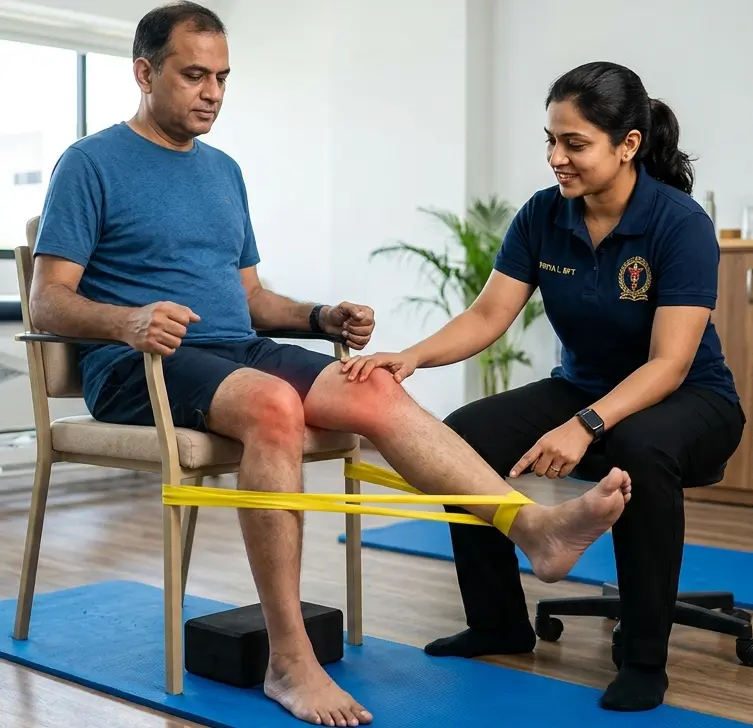
6. Resistance Band Knee Exercises
Resistance band knee exercises may help improve controlled strengthening when guided correctly.
7. Manual Therapy
Manual therapy may help reduce stiffness and improve movement when suitable for the patient.
8. Balance and Stability Training
Knee stability exercises support better control while walking, turning, climbing stairs, or returning to sports
Safe Knee Pain Exercise at Home
A few simple exercises may be used at home only when pain is mild and there is no major swelling or injury.
Heel Slides
Lie down or sit with legs straight. Slowly bend the knee by sliding the heel toward the body, then straighten again.
Quad Sets
Keep the leg straight. Tighten the thigh muscle gently and hold for a few seconds.
Straight Leg Raise
Lie down, keep one knee bent and the painful side straight. Lift the straight leg slowly and lower it with control.
Seated Knee Extension
Sit on a chair. Slowly straighten the knee, hold briefly, and lower it back.
Calf Raises
Stand with support. Slowly lift heels up and lower down.
Do these only if comfortable. Stop if pain increases, swelling worsens, or movement becomes difficult.
Prevention and Home Care Tips
- Avoid sitting too long without movement
- Warm up before exercise
- Avoid sudden heavy squats if painful
- Strengthen thigh and hip muscles
- Wear supportive footwear
- Maintain healthy body weight
- Avoid overtraining
- Use stairs carefully during pain flare-ups
- Follow physiotherapist-guided exercises
- Do not force painful movements
Versus Arthritis also advises getting professional advice if you have concerns before starting a new exercise plan.
When to Consult a Physiotherapist
Consult a physiotherapist if:
- Knee pain lasts more than a few days
- Pain affects walking or stairs
- You feel knee weakness
- Pain comes after sports injury
- You have swelling or stiffness
- You cannot bend or straighten the knee properly
- Pain keeps coming back
- You need physiotherapy for knee pain at home
- You are recovering after surgery
- You are unsure which exercise is safe
Seek urgent medical help if the knee is very painful, badly swollen, changed shape, locked, giving way, or you cannot put weight on it.
Physiotherapy Near Me in Chennai
If you are searching for physiotherapy near me in Chennai for knee pain, Fitsiomax Physiotherapy & Fitness Centre provides care across Chennai.
You can visit:
- Physiotherapy clinic in Anna Nagar
- Physiotherapy clinic in T. Nagar
- Physiotherapy clinic in Parrys
- Physiotherapy clinic in ECR
Patients looking for physiotherapy for knee pain, knee pain relief exercises, knee rehab exercises, knee strengthening exercise, and knee pain treatment at home guidance can visit the nearest Fitsiomax branch for professional assessment.
Why Choose Fitsiomax in Chennai?
Fitsiomax Physiotherapy & Fitness Centre focuses on pain relief, rehabilitation, posture correction, fitness, and movement recovery.
Fitsiomax helps with:
- Knee pain physiotherapy
- Knee pain relief exercises
- Knee strengthening exercises
- Knee rehab exercises
- Sports injury care
- Post-surgery rehabilitation
- Senior citizen mobility support
- Physiotherapy for knee pain at home guidance
- Exercise correction
- Mobility improvement
The goal is to help patients move better, reduce discomfort, and return to daily activities safely.
Conclusion
Knee pain should not be ignored when it affects walking, stairs, sleep, work, or exercise. The right physiotherapy exercise for knee pain may help improve movement, support muscle strength, reduce stiffness, and guide safe recovery.
If you have knee pain, weakness, stiffness, sports injury, or post-surgery movement difficulty, visit Fitsiomax Physiotherapy & Fitness Centre in Anna Nagar, T. Nagar, Parrys, or ECR.
Book your physiotherapy consultation at Fitsiomax Chennai today.
Visit fitsiomax.clinic | Call us | Walk into our clinic in Chennai
Frequently Asked Questions
1. What causes stiff back and neck pain?
Stiff back and neck pain may happen due to poor posture, long sitting, muscle tightness, weak muscles, sleeping position, injury, or reduced movement.
2. Can physiotherapy help stiff neck and back pain?
Yes. Physiotherapy may help improve mobility, reduce stiffness, correct posture, strengthen muscles, and guide safe exercises.
3. Why do my back and neck hurt after sleeping?
It may happen due to poor sleeping posture, pillow height, mattress support, or muscle stiffness from staying in one position for too long.
4. What exercises help stiff neck pain?
Gentle neck movements, shoulder rolls, upper back mobility, and posture exercises may help, but severe pain should be assessed by a physiotherapist.
5. When should I visit Fitsiomax for back neck pain?
Visit Fitsiomax if pain lasts for days, affects sleep or work, keeps returning, spreads to the shoulder or arm, or limits movement.